A new 2025 market report prepared by AVX Cloud estimates that nearly four in ten New Jersey businesses continue to rely on legacy telephone infrastructure, with rising maintenance costs, employee workarounds and hybrid-work limitations increasing the operational cost of keeping older systems in place.
NEW JERSEY – A new report prepared by AVX Cloud estimates that approximately 39% of New Jersey businesses continued using legacy phone systems in 2025, including traditional on-premises PBX platforms, analog telephone lines and older non-cloud VoIP systems. The findings suggest that while many of these systems remain functional, the cost and operational burden associated with maintaining them is increasing.
The 2025 New Jersey Business Phone System Report examines the prevalence, costs and operational effects of aging telecommunications infrastructure across the state. The report is based on a composite modeled dataset representing approximately 1,850 New Jersey businesses, weighted according to company size and industry.
Among its primary findings, the report estimates that maintenance and support expenses for legacy phone systems increased approximately 18% between 2022 and 2025. Median annual total cost of ownership for a 50-employee location reached approximately $4,800 to $6,200, while 31% of modeled legacy-system users experienced an unexpected repair or upgrade expense during the previous 12 months.
The report suggests that these trends are changing how businesses should evaluate communications technology. Rather than comparing a cloud phone platform only against the monthly telephone bill, organizations may need to consider maintenance, carrier charges, repairs, employee time, downtime, remote-work limitations and administrative overhead when calculating the effective cost of an older system.
Rising Costs Are Changing the Economics of Legacy Phone Systems
One of the most significant findings involves the growing expense associated with maintaining aging telecommunications infrastructure. The report estimates that annual maintenance and support costs increased approximately 18% between 2022 and 2025 as organizations dealt with aging equipment, replacement components, technical support and carrier-related expenses.
For a 50-employee New Jersey location, estimated annual total cost of ownership reached approximately $4,800 to $6,200 in 2025, compared with roughly $3,900 in 2022. Those expenses can include hardware replacement, PBX support contracts, telephone lines, technician visits, software support, outages and emergency repairs.
Unexpected equipment failures can create an additional budgeting challenge. Businesses represented in the modeled research that experienced unexpected repairs or upgrades incurred approximately $1,400 to $2,100 per incident, while roughly 31% of legacy-system users experienced at least one such event during the previous year.
Traditional carrier services are also contributing to higher costs. The report estimates that analog line, PRI circuit and other traditional line or trunk charges increased approximately 9% to 12% year over year among the New Jersey businesses represented in the research, creating a situation in which some organizations may be paying more each year without receiving additional functionality.
Employees May Be Losing Nearly an Hour Each Week to Phone-System Workarounds
The financial impact of an aging business phone system is not limited to invoices from carriers or technicians. The report estimates that employees at legacy-dependent businesses spent approximately 47 to 62 minutes each week dealing with telecommunications-related workarounds and limitations.
Common problems included inconsistent call quality, dropped connections, limited mobile functionality, difficulty transferring calls remotely, weak CRM integration and manual call routing. Individually, these interruptions may appear minor, but across a larger workforce the accumulated time can become significant.
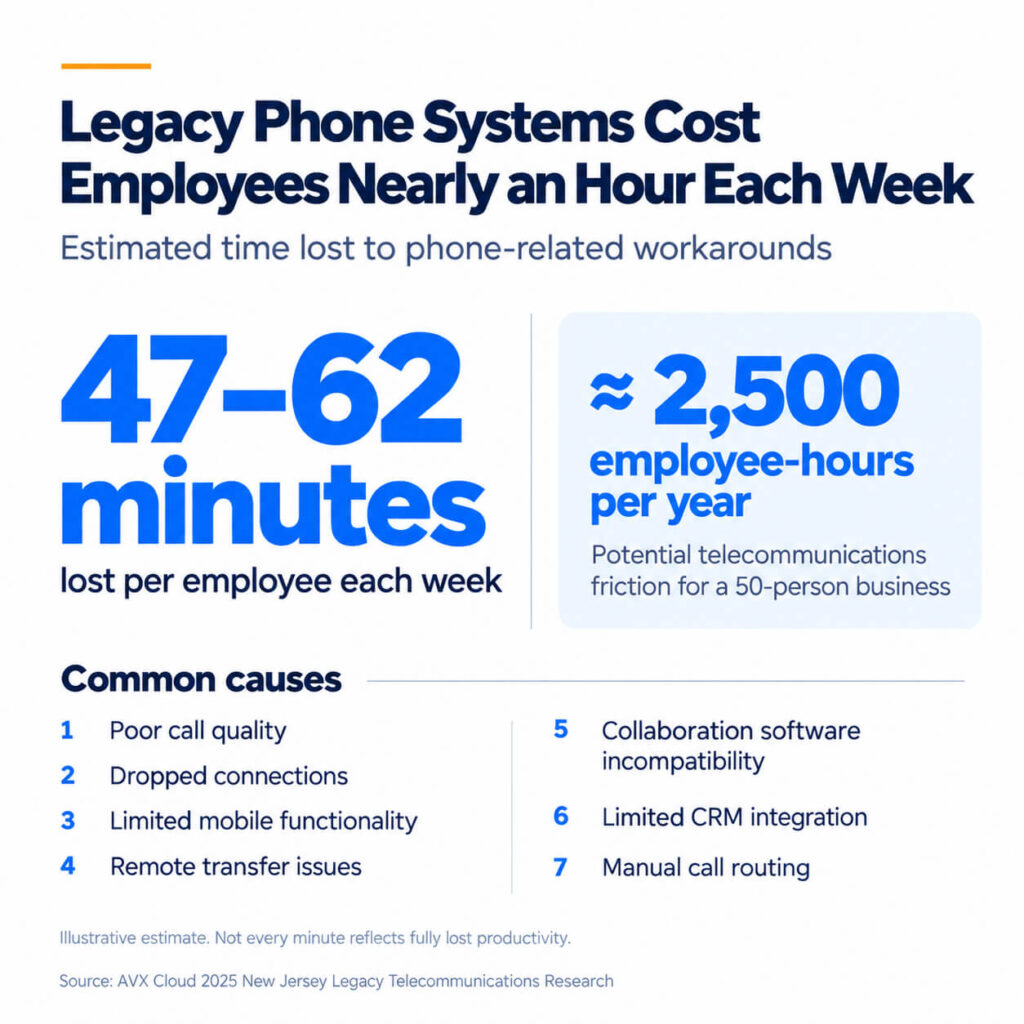
For example, the report notes that a 50-person organization losing approximately one hour per employee each week could experience roughly 2,500 employee-hours per year of telecommunications-related friction. The report cautions that not every minute should be interpreted as completely lost productivity, but the calculation illustrates how small communication problems can compound across an organization.
Managers reported similar concerns. Approximately 28% of managers represented in the modeled dataset estimated that legacy communications systems contributed to 3% to 5% lower productivity on communication-heavy activities such as client conversations, sales calls, internal coordination, customer service, scheduling and vendor communication.
Hybrid Work Is Exposing Limitations in Older Business Phone Systems
The shift toward remote and hybrid work has created another point of pressure for businesses still operating telephone systems designed around a centralized office. The report estimates that approximately 41% of legacy-system users experienced measurable coordination delays related to limited mobile access, remote functionality or analytics.
Traditional systems typically connect employees to physical desk phones and infrastructure located inside an office. Modern organizations, however, may need employees to answer calls from home, travel between sites, use mobile devices or collaborate with teams operating from several locations.
Cloud communications platforms are designed to extend the same business identity across those environments. Depending on the configuration, businesses can use desktop and mobile applications, centralized call routing, voicemail transcription, analytics, CRM integrations, conferencing and multi-location administration through one communications environment.
Manufacturing and Midsized Businesses Show the Highest Legacy Usage
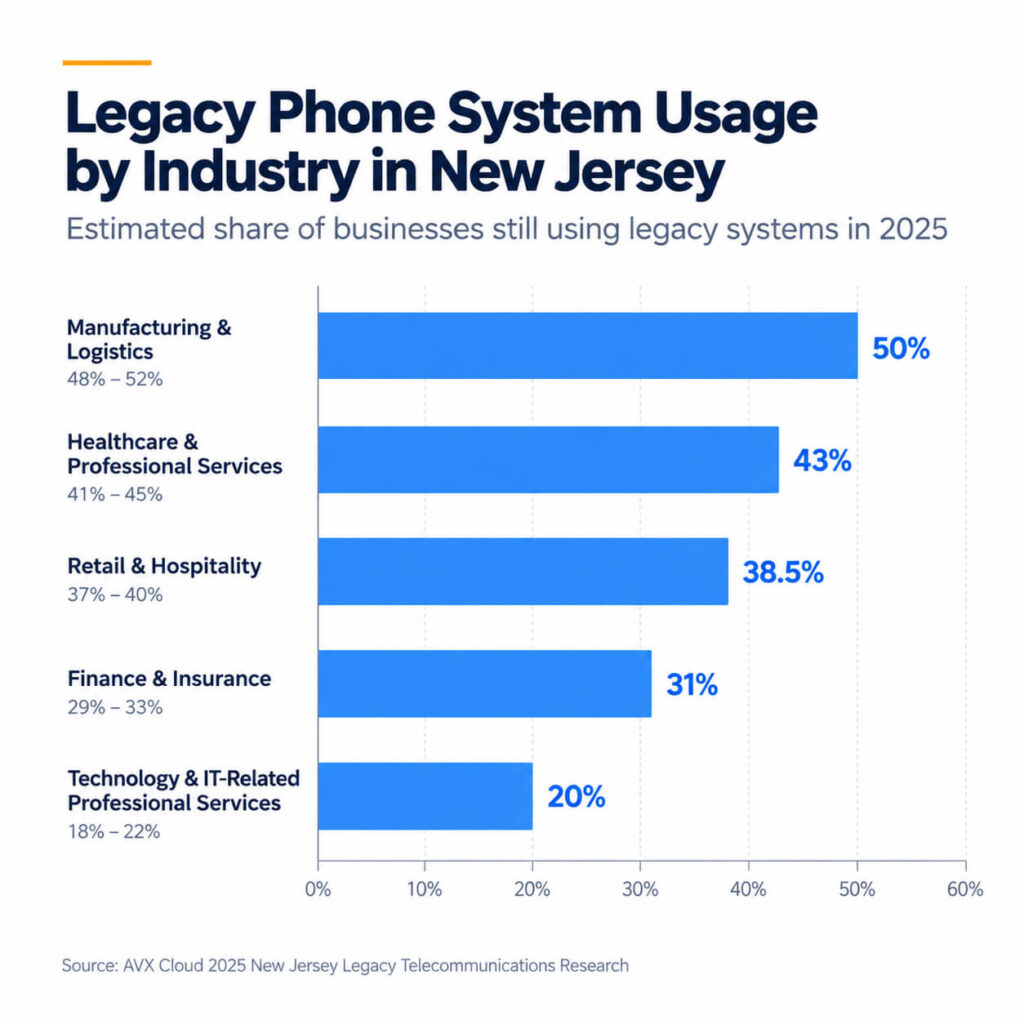
Legacy phone-system adoption varies considerably across New Jersey industries, according to the report. Manufacturing and logistics businesses had the highest estimated usage at approximately 48% to 52%, followed by healthcare and professional services at approximately 41% to 45%.
Retail and hospitality businesses were estimated at 37% to 40%, while finance and insurance organizations were lower at approximately 29% to 33%. Technology-oriented businesses had the lowest estimated legacy-system adoption, ranging from approximately 18% to 22%.
Company size also appears to influence migration decisions. The highest estimated legacy usage occurred among businesses with 20 to 499 employees, including approximately 42% to 46% of organizations with 20 to 99 employees and 45% to 49% of those with 100 to 499 employees.
The report suggests these midsized organizations can face a difficult combination of factors. They may have enough locations, extensions and existing infrastructure to make a migration more involved, while lacking the dedicated technology resources and formal refresh cycles typically available to larger enterprises.
Businesses Are Being Encouraged to Calculate the Full Cost of Delaying Migration
The findings suggest that determining whether to modernize a business phone system requires more than asking whether the existing equipment still works. A system can continue making and receiving calls while simultaneously generating higher maintenance expenses, employee inefficiencies and limitations around mobile or remote work.
AVX Cloud’s report recommends evaluating carrier charges, hardware replacement, maintenance contracts, technician support, emergency repairs, employee workarounds, downtime, integration limitations and administrative overhead when comparing legacy infrastructure with modern cloud communications.
For New Jersey businesses experiencing recurring repairs, increasing carrier costs, limited remote functionality or repeated employee workarounds, conducting a complete cost comparison can help determine whether continuing to maintain an older system remains financially justified. The report indicates that cloud communications and UCaaS platforms have become the dominant migration path among the businesses represented in the 2025 dataset.
New Jersey businesses considering a phone-system modernization can use the report as a framework for evaluating both the direct and indirect costs of their current communications environment and determining whether migration could provide an operational or financial benefit.
About AVX Cloud
AVX Cloud provides VoIP phone systems to NJ businesses and small enterprises. The company works with businesses looking to modernize communications, support remote employees, simplify multi-location management and move away from traditional on-premises phone systems.
AVX Cloud helps organizations evaluate VoIP and cloud communications platforms based on their existing infrastructure and operational requirements. For businesses still using legacy telecommunications technology, the company can also help assess the current communications environment and identify opportunities to reduce complexity and modernize business phone systems.
Contact Information
Name: AVX Cloud – NJ Business Phone Systems and VOIP Services
Address: 2 Emerson Ln, Suite 209 Secaucus, NJ 07094
Phone Number: 201-340-9101
Website: https://www.avxcloud.com/
Media gallery