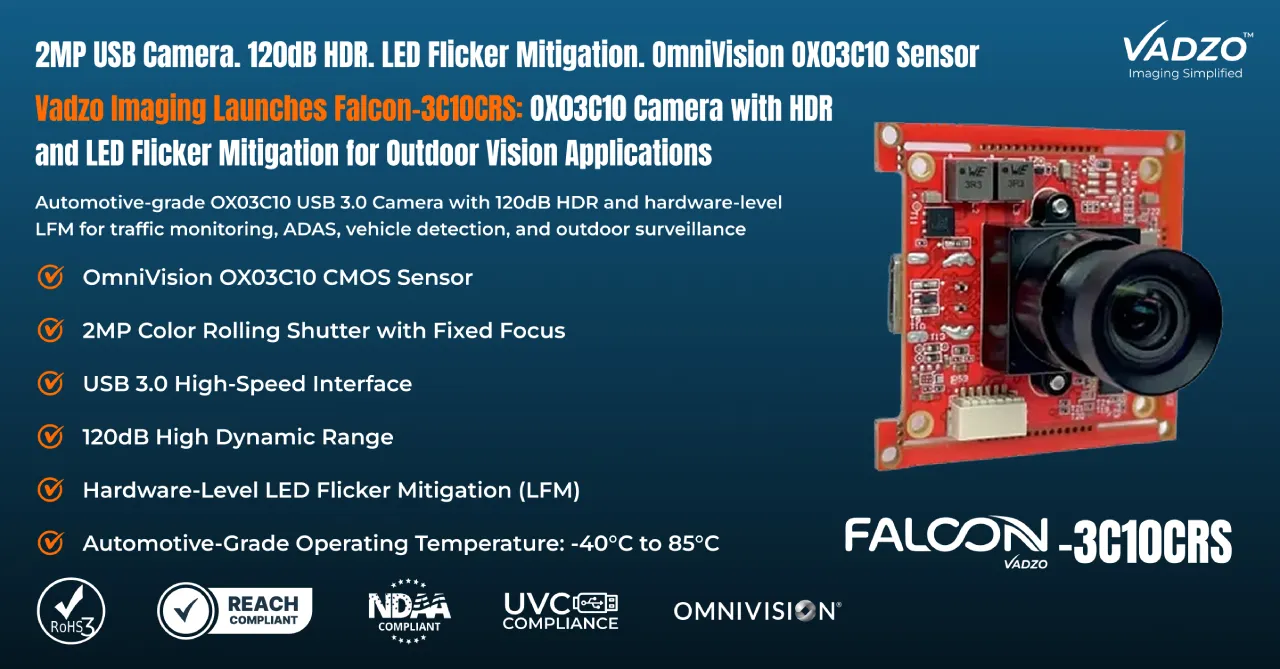
The Falcon-3C10CRS is a 2MP Color Rolling Shutter USB 3.0 Camera built on the OmniVision OX03C10 sensor. It is designed for outdoor traffic monitoring, ADAS integration, vehicle detection, roadside surveillance, and transportation vision systems. It delivers an OX03C10 USB camera with a 120dB high dynamic range, hardware-level LED Flicker Mitigation, and automotive-grade operating temperature support through a plug-and-play USB 3.0 interface in a compact S-Mount form factor.
FORT WORTH, TX / ACCESS Newswire / June 12, 2026 / Vadzo Imaging, a provider of embedded vision camera products, today announces the launch of the Falcon-3C10CRS OX03C10 camera. Built on the OmniVision OX03C10 sensor and part of Vadzo’s USB camera portfolio, the Falcon-3C10CRS delivers 2MP color rolling shutter imaging with 120dB high dynamic range and hardware-level LED Flicker Mitigation (LFM) through a USB 3.0 interface. With this launch, Vadzo delivers a high-performance OX03C10 HDR Camera that addresses two simultaneous failure modes in outdoor vision systems: extreme scene dynamic range from direct sunlight and deep shadows, and LED flicker artifacts introduced by traffic signals and roadside luminaires operating on AC power. This enables deployment across intelligent traffic systems, ADAS platforms, vehicle detection infrastructure, and outdoor surveillance networks with direct plug-and-play USB 3.0 host integration.
The Dual Challenge in Outdoor Vision Systems
Outdoor vision systems deployed for traffic monitoring, ADAS, and roadside surveillance encounter two lighting problems simultaneously. The first is the dynamic range. A single scene at an outdoor intersection can contain direct sunlight, deep vehicle shadows, headlight glare, and overcast sky regions all in the same frame. Standard cameras operating at 60 to 70dB dynamic range must sacrifice either highlight or shadow detail, making it impossible to extract reliable vehicle or license plate information across the full scene in a single captured frame.
The second problem is LED flickers. Traffic signals, street luminaires, and roadside LED panels in most countries operate on AC power grids at 50Hz or 60Hz. When a rolling shutter camera exposure window does not synchronize with the LED refresh cycle, the sensor reads the signal during a partial ON phase. The resulting image contains dark horizontal banding artifacts that vary from frame to frame. For smart traffic camera systems performing signal state identification, vehicle detection, or license plate recognition, these artifacts corrupt the image data before it reaches the inference pipeline. Addressing both problems through software post-processing adds latency and reduces reliability. The OX03C10 sensor resolves both challenges at the hardware level within a single imaging path.
Sensor and Camera Overview
The Falcon-3C10CRS is a 2MP Color Rolling Shutter USB Camera built on the OmniVision OX03C10 sensor and is coupled with a high-performance ISP. The OX03C10 is a 2MP (1920 x 1280) color rolling shutter CMOS sensor with a 1/2.7-inch optical format and 3.0 µm pixel size. The OX03C10 sensor integrates a 120dB multi-exposure HDR architecture and an embedded LED Flicker Mitigation engine that resolves both the contrast challenge of outdoor scenes and the temporal interference of AC-powered LED lighting in a single exposure cycle. This combination of wide dynamic range and hardware flicker suppression makes the Falcon-3C10CRS particularly well suited for outdoor HDR camera deployments in traffic monitoring, ADAS, and automotive vision environments where lighting conditions are outside system control.
The Falcon-3C10CRS is a compact USB 3.0 camera solution. The camera module houses the OmniVision OX03C10 sensor, ISP, and fixed focus lens assembly in an S-Mount (M12) lens holder configuration. The camera operates across -40°C to 85°C, covering the automotive-grade temperature range required for outdoor infrastructure mounting in environments from arctic winter installations to desert summer deployments. The OX03C10 USB Camera connects via USB 3.0 to any host system and is UVC compliant for immediate recognition on Windows, Linux, and macOS without proprietary driver installation. Supported output modes include full 2MP resolution as well as 1080p and 720p, enabling the same module to serve both full-resolution recording and real-time inference workloads.
Key specs: 2MP (1920 x 1280) | OmniVision OX03C10 1/2.7 inch 3.0 µm pixel | Color | Rolling Shutter | Fixed Focus | 120dB HDR | LED Flicker Mitigation (LFM) | High-Performance ISP | USB 3.0 | 2MP / 1080p / 720p | S-Mount (M12) | -40°C to 85°C | Windows / Linux / macOS
Key Capabilities of the Falcon-3C10CRS: OX03C10 HDR LFM USB 3.0 Camera
LED Flicker Mitigation for Traffic Signal and Roadside LED Imaging:
LED traffic signals and roadside luminaires operate on AC power cycles at 50Hz or 60Hz, depending on the regional power grid. When a rolling shutter camera exposure window does not align with the LED refresh period, the readout captures partial ON states across consecutive row exposures. This produces dark banding artifacts across the frame in a pattern that varies from frame to frame, rendering the captured image unreliable for any downstream algorithm that depends on consistent pixel values in the lit regions of the scene.
The OmniVision OX03C10 includes a hardware-level LED Flicker Mitigation engine that synchronizes the sensor’s exposure timing to the LED refresh cycle. This eliminates flicker bands at the point of capture, producing artifact-free frames regardless of whether the luminaire in the scene is a traffic signal, a streetlamp, or an LED roadside panel. The LFM USB Camera delivers this capability through USB 3.0 without post-processing compensation or software-based correction that introduces additional latency into the vision pipeline. The LFM frequency is configurable for both 50Hz and 60Hz AC grids, making the Falcon-3C10CRS deployable across North American, European, and Asia-Pacific transportation infrastructure without hardware change.
120dB HDR for Outdoor Scene Dynamic Range:
Outdoor vision systems routinely encounter scenes that span luminance ratios exceeding what standard cameras with a 60 to 70dB dynamic range can represent. A forward-facing traffic monitoring camera in the afternoon sun must simultaneously capture vehicle body detail in full shadow under a bridge and registration plate characters against a bright sky background. Standard cameras clip at one end of this range and lose the detail that traffic analytics, ADAS, and vehicle detection algorithms require.
The OX03C10 sensor delivers a 120dB dynamic range through a multi-exposure HDR architecture embedded at the sensor level. The 120dB HDR camera captures both highlight and shadow detail in a single output frame without relying on tone mapping software or dual-camera setups. For outdoor HDR camera deployments in roadside surveillance, vehicle detection, and transportation vision systems, this means reliable image quality from pre-dawn conditions to direct midday sunlight without manual exposure adjustment or scene-specific recalibration when lighting transitions between morning and afternoon.
Automotive-Grade Temperature for Year-Round Outdoor Infrastructure
Most embedded USB cameras target commercial operating temperature ranges that do not cover the thermal extremes encountered in outdoor infrastructure. The Falcon-3C10CRS is built on the OmniVision OX03C10 sensor and operates across -40°C to 85°C. This automotive-grade temperature range covers arctic winter roadside installations, rooftop traffic monitoring enclosures in desert climates, and vehicle-mounted camera payloads where internal enclosure temperatures can reach 85°C under direct sun exposure. For roadside camera infrastructure and transportation vision system integrators building systems that must operate continuously across seasonal extremes, this temperature specification removes the thermal failure mode that disqualifies commercial-grade USB camera alternatives from consideration.
2MP Color Resolution for Vehicle Classification and Plate Extraction
At 2MP (1920 x 1280), the Falcon-3C10CRS captures sufficient spatial resolution for vehicle body detail, color classification, and license plate character extraction at typical roadside camera mounting distances. The 3.0 µm pixel size on the 1/2.7-inch optical format sensor provides adequate per-pixel light collection for reliable color output in overcast and reduced-ambient-light conditions. The color rolling shutter architecture supports frame-by-frame vehicle color classification without the resolution penalty associated with monochrome alternatives. For vehicle detection camera and smart traffic camera deployments where vehicle color is a classification feature alongside type and plate recognition, the full-color 2MP output is a direct system-level benefit rather than an aesthetic preference.
USB 3.0 Plug-and-Play Integration
The Falcon-3C10CRS OX03C10 USB Camera connects directly to any USB 3.0 host port on Windows, Linux, and macOS without additional interface boards. UVC class driver compliance means the camera operates immediately upon connection. This reduces development time for traffic monitoring camera system integrators and transportation vision camera deployments where field installation timelines matter. The USB 3.0 bandwidth accommodates full 2MP output at practical frame rates without compression, and USB power delivery simplifies cabling in enclosure designs that must minimize connector penetrations for IP-rating compliance.
Compact S-Mount Form Factor for Infrastructure and Vehicle Integration
The Falcon-3C10CRS ships in a compact module footprint with an S-Mount (M12) lens holder that accepts any standard M12 threaded optic. System integrators can select from wide-angle lenses for forward vision camera wide-FOV coverage to narrow-field optics for long-distance vehicle detection or license plate reading. The compact form factor enables integration into roadside enclosures, traffic camera housing, vehicle-mounted ADAS camera payloads, surround view camera systems, and embedded transportation vision platforms where board space and module weight are constrained by the installation environment.
“Traffic and outdoor vision cameras face two problems that most sensors address separately: extreme dynamic range from outdoor sunlight and LED flicker from signal infrastructure. The OX03C10 sensor in the Falcon-3C10CRS resolves both in hardware. The 120dB HDR captures the full outdoor scene without clipping, and the LED Flicker Mitigation engine eliminates AC power artifacts that corrupt traffic signal imaging. By delivering these capabilities through USB 3.0 in an automotive-grade module, Vadzo gives system integrators a purpose-built HDR LFM USB Camera that is ready for roadside deployment without thermal limitations or optical workarounds. For OEM teams building transportation vision systems, that is meaningful engineering time saved at every stage.”- Alwin Vincent, Product Manager, Vadzo Imaging
Applications
Traffic Monitoring and Vehicle Detection: Intelligent traffic systems and vehicle detection camera networks require reliable image capture across the full range of outdoor conditions, from overcast to direct sunlight and from dawn to artificial nighttime illumination. The Falcon-3C10CRS delivers 120dB HDR for handling direct sunlight, headlight glare, and nighttime illumination within the same camera deployment. The HDR traffic camera LED Flicker Mitigation engine eliminates the banding artifacts that affect smart traffic camera systems by reading signal states or performing license plate recognition near LED signals and luminaires. The 2MP color output supports vehicle color classification, type identification, and character-level plate detail at typical roadside camera mounting distances.
ADAS and Forward Vision Platforms: Advanced Driver Assistance Systems and forward vision camera platforms deployed in vehicle or roadside configurations face continuous lighting variation across tunnels, bridges, and open road segments where illumination transitions rapidly. The Falcon-3C10CRS ADAS USB Camera delivers a consistent 120dB dynamic range of capture across these transitions. LED Flicker Mitigation is particularly relevant for forward-facing ADAS deployments that must correctly interpret LED brake lights, traffic signals, and LED variable message signs without false reads caused by exposure-timing artifacts at highway speeds.
Outdoor Surveillance and Roadside Vision: Outdoor surveillance HDR camera installations at road junctions, perimeter boundaries, and infrastructure monitoring points require cameras that perform across weather variations, temperature extremes, and full day-night cycles. The Falcon-3C10CRS combines -40°C to 85°C automotive-grade operation with 120dB HDR and LFM in a USB 3.0 module. This allows a single outdoor surveillance HDR camera module to cover the complete 24-hour operational cycle without sensitivity degradation or thermal shutdown that affects commercial-grade alternatives installed in exposed outdoor enclosures without climate control.
Automotive Vision and Surround View Systems: Surround-view camera systems and automotive vision camera deployments require consistent image output from sensors mounted at positions that encounter diverse lighting conditions simultaneously. A rear-facing camera may face direct headlight exposure from trailing vehicles, while the forward camera addresses sun glare from the opposite direction. The Falcon-3C10CRS automotive HDR imaging capability handles this per-position exposure challenge through hardware-level HDR and LFM without relying on active gain manipulation that introduces noise into downstream inference pipelines.
Transportation Vision and Smart Infrastructure: Transportation vision camera Networks and intelligent traffic camera deployments serving road-level and elevated mounting positions benefit from the Falcon-3C10CRS combination of automotive-grade temperature tolerance, 120dB HDR, and LED Flicker Mitigation. For smart infrastructure integrators building systems that must operate for years without maintenance access, the -40°C to 85°C specification and hardware-level LFM capability reduce the environmental and optical failure modes that drive unplanned service visits in legacy surveillance camera infrastructure deployed along transportation corridors.
Frequently Asked Questions
1) What is LED Flicker Mitigation, and why does it matter more for outdoor camera systems than standard exposure control?
Standard exposure control adjusts how long the sensor collects light per frame, but it does not account for the periodic ON/OFF cycling of LED light sources driven by AC power grids. When the shutter timing and the LED cycle are out of phase, the sensor reads partial ON states during row readout, and the result is dark horizontal bands appearing across the frame. Vadzo’s purpose-built LED Flicker Mitigation Camera solves this at the hardware level by synchronizing the OX03C10 sensor’s exposure window to the LED refresh cycle, eliminating the banding condition. No software correction, no frame-averaging workaround, and no added latency. Vadzo builds this capability into the camera because outdoor deployments do not give engineers the luxury of controlling the luminaire infrastructure in the scene.
2) How does 120dB dynamic range change what is achievable in outdoor roadside deployments?
Most standard cameras operate in the 60 to 70dB range, which is enough for controlled indoor lighting but falls well short of what outdoor scenes demand. A single roadside scene can span from direct afternoon sunlight to the deep shadow under a vehicle in a single frame, a contrast ratio that a 70dB sensor cannot represent without losing critical detail at one end. The OX03C10’s 120dB HDR camera architecture captures that full range in a single output frame, giving traffic analytics and vehicle detection algorithms complete image data without highlight clipping or shadow crush. Vadzo chooses sensors based on what the deployment environment actually demands, not on what is easiest to manufacture.
3) Does this camera work in both 50Hz and 60Hz power grid regions without hardware changes?
Yes. The OX03C10 LED Flicker Mitigation engine is configurable for both 50Hz and 60Hz AC power grids. This means the same anti-flicker USB camera module deploys in North American 60Hz infrastructure and European or Asia-Pacific 50Hz environments without requiring a different sensor, lens, or hardware assembly. Frequency selection is managed through the Vispa ARC SDK or UVC extension unit controls. Vadzo designs this flexibility from the start because transportation vision camera customers deploy across multiple regions, and hardware redesigns for grid frequency differences are unacceptable at scale.
4) Why does automotive-grade temperature specification matter for camera infrastructure that is not mounted on a vehicle?
Roadside enclosures, traffic signal poles, and elevated gantry mounts expose cameras to the same thermal extremes that vehicle-mounted cameras face. A black metal enclosure on a south-facing pole in a desert climate can reach 75 to 85°C internally in midsummer. Northern European or North American winter installations can expose the camera to -30°C or below. Commercial-grade cameras rated to 0°C or 70°C fail in both scenarios. The Falcon-3C10CRS operates across -40°C to 85°C because Vadzo’s roadside vision camera customers build infrastructure that is expected to run for years without service access. Meeting the automotive-grade specification is the engineering commitment that backs up that expectation.
5) How does Vadzo Imaging support OEM teams who need customized versions of this camera for production integration?
Vadzo Imaging proudly supports full OEM customization of the Falcon-3C10CRS beyond the standard evaluation module. This includes custom lens selection and factory focus calibration for specific roadside mounting distances, enclosure design for IP-rated outdoor deployment, firmware modifications for LFM frequency tuning and exposure parameter locking, and platform-specific driver development for embedded computer hardware used in transportation vision systems. Evaluation samples with full technical documentation are available with no minimum order requirement, and Vadzo’s applications engineering team works directly with OEM integration teams from evaluation through production ramp. Contact Vadzo at support@vadzoimaging.com to begin the conversation.
Availability
The Falcon-3C10CRS OX03C10 camera, built on the OmniVision OX03C10 sensor, is now available for evaluation and production orders. Evaluation kits include the camera module, S-Mount fixed focus lens, USB 3.0 cable, and platform driver documentation with no minimum order requirement. Browse the full Vadzo USB camera portfolio at https://www.vadzoimaging.com/ or contact Vadzo at support@vadzoimaging.com to request an evaluation kit or discuss OEM integration requirements.
About Vadzo Imaging
Vadzo Imaging is a global provider of embedded vision solutions and delivers high-performance camera technologies and imaging platforms for applications in robotics, industrial automation, UAVs, edge AI, medical systems, and smart infrastructure. Its products are designed for seamless integration with leading embedded platforms. Vadzo supports customers through hardware customization, firmware development, and module-level drivers, enabling faster development and deployment of vision-based systems.
Media Contact
Alwin Vincent
Vadzo Imaging
Email: alwin@vadzoimaging.com
LinkedIn: Vadzo Imaging
YouTube: Vadzo Imaging
X: Vadzo Imaging
View the original press release on ACCESS Newswire


