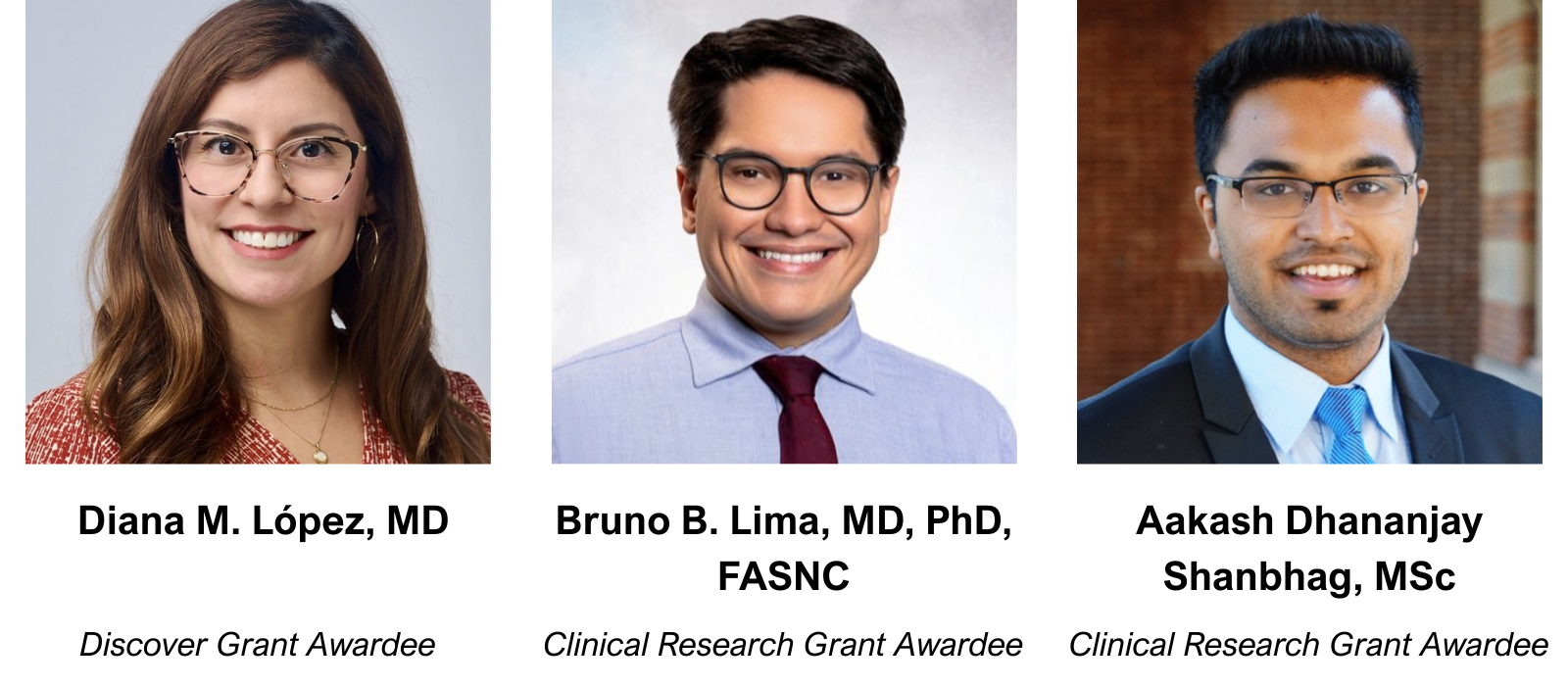
FAIRFAX, VA, UNITED STATES, June 8, 2026 /EINPresswire.com/ — The American Society of Nuclear Cardiology (ASNC) is pleased to announce the recipients of the Society’s inaugural Discover Grant and Clinical Research Grants. Established to support innovative science while investing in the careers of ASNC members, ASNC’s 2026 Research Awards Program is providing $125,000 in research funding through one Discover Grant and two Clinical Research Grants.
“ASNC is proud to launch this new research awards program as part of the Society’s commitment to advancing innovation in nuclear cardiology and cardiovascular imaging, fostering the next generation of scientific leaders, and supporting work with potential to improve patient care,” said ASNC President Jamieson M. Bourque, MD, MHS, FASNC. “The quality and vision of these inaugural awardees reflect the bright future of nuclear cardiology.”
First ASNC Discover Grant Awardee
The ASNC Discover Grant provides $75,000 over 18 months to support transformative clinical research in nuclear cardiology.
Diana M. López, MD
Diana M. López, MD, is an instructor in medicine at Harvard Medical School and an associate physician at Brigham and Women’s Hospital in Boston, Massachusetts. Her project is Impact of Initial PET vs CCTA on Diagnostic and Therapeutic Pathways in Cardiometabolic Disease.
Dr. López’s project will examine how cardiac PET and coronary CT angiography (CCTA) influence downstream testing and treatment decisions in patients with cardiometabolic disease, a population in which coronary artery disease can be difficult to assess because it often involves diffuse atherosclerosis and coronary microvascular dysfunction rather than focal stenosis. Her research will develop and validate a target trial emulation framework to compare how PET versus CCTA shapes clinical decision-making and care pathways. The project is intended to establish the methodological and data infrastructure for a future multicenter study focused on improving diagnostic efficiency, reducing unnecessary invasive testing, and optimizing care for patients with both obstructive and nonobstructive coronary artery disease.
First ASNC Clinical Research Grant Awardees
ASNC’s Clinical Research Grants provide $25,000 over 18 months to support mentored research projects led by early-career investigators.
Bruno B. Lima, MD, PhD, FASNC
Bruno B. Lima, MD, PhD, FASNC, is an assistant professor of Medicine and Radiology at Vanderbilt University Medical Center in Nashville, Tennessee. His project is Multicenter Validation of Dynamic SPECT Quantitative Myocardial Blood Flow for Noninvasive Assessment of Cardiac Allograft Vasculopathy.
Dr. Lima’s research will focus on developing a multicenter database of CZT-SPECT quantitative myocardial perfusion imaging in heart transplant recipients to support noninvasive assessment of cardiac allograft vasculopathy. By combining data from Vanderbilt University Medical Center, the University of Rochester, and additional collaborating institutions, the study aims to evaluate hundreds of transplant patients and develop a quantitative scoring approach similar to the PET-CAV score. The project addresses the need for more accessible screening tools for cardiac allograft vasculopathy, particularly in centers and regions where PET imaging is not widely available.
Aakash Dhananjay Shanbhag, MSc
Aakash Dhananjay Shanbhag, MSc, is a PhD candidate at the University of Southern California and a senior programmer analyst at the Artificial Intelligence in Medicine Research Center in the Department of Medicine at Cedars-Sinai Medical Center in Los Angeles, California. His project is Robust Development and Validation of Synthetic Attenuation Correction for PET.
Mr. Shanbhag’s project will focus on the development and validation of synthetic attenuation correction methods for cardiac PET imaging using artificial intelligence. Current attenuation correction approaches rely primarily on CT and can be vulnerable to misregistration artifacts and other technical limitations that affect clinical reliability. His research aims to rigorously evaluate AI-driven alternatives to ensure clinical equivalence while minimizing the risk of unintended bias or image artifacts. The work is designed to improve the reliability, accessibility, and quantitative accuracy of cardiac PET imaging and support broader access to advanced nuclear cardiology care.
The recipients will be recognized during ASNC2026, Sept. 16-19, 2026, in Las Vegas, Nevada.
###
About ASNC, the American Society of Nuclear Cardiology
The American Society of Nuclear Cardiology is the international home for nuclear cardiology and the largest professional society devoted exclusively to the field. ASNC’s membership includes more than 5,900 nuclear cardiology professionals from around the world. Founded in 1993, ASNC’s mission is to improve cardiovascular outcomes through image-guided patient management. ASNC establishes standards for excellence in cardiovascular imaging through the development of clinical guidelines, professional medical education, advocacy, and research. ASNC’s official publication is the Journal of Nuclear Cardiology, https://www.journalofnuclearcardiology.org.
Learn more at http://www.asnc.org.
Kathy David
American Society of Nuclear Cardiology (ASNC)
+17034592555 ext.
email us here
Visit us on social media:
LinkedIn
Bluesky
Instagram
Facebook
YouTube
X
Legal Disclaimer:
EIN Presswire provides this news content “as is” without warranty of any kind. We do not accept any responsibility or liability
for the accuracy, content, images, videos, licenses, completeness, legality, or reliability of the information contained in this
article. If you have any complaints or copyright issues related to this article, kindly contact the author above.

Media gallery